What you need before a Gweike M-Series arrives
Prepare the whole route from the truck to the final machine position—not just the footprint. Confirm requirements against the packing list and electrical label for the exact configuration you bought; M-Series power, source, chiller, and accessory combinations vary.
Do not design from one internet number
The manual includes a high total-load planning figure, while real installations may distribute machine, source, chiller, compressor, and extraction across supplies. A qualified electrician must size protection, conductors, isolation, and earthing for the delivered equipment and local code.
Delivery and placement
- Measure doors, turns, ceiling height, slopes, thresholds, and the unloading area.
- Obtain packed dimensions and weights for every crate from Gweike or the freight paperwork.
- Use lifting equipment rated for the actual load and an operator trained for it.
- Choose a firm, level, non-combustible floor with service access around doors, panels, filters, and the chiller.
- Leave a straight, protected route for the laser-source fiber cable. Its bend is broad; it must never be crushed, twisted, or used as a handle.
- Keep combustible stock, solvents, gas cylinders, and the fume discharge away from the cutting area.
Utilities checklist
Electrical
Ask the electrician to inspect the actual nameplates and supplied drawings, then provide the correct voltage/frequency, circuit capacity, protective earth, local isolator, and overcurrent protection. Confirm how the main machine, source, chiller, compressor, and extraction are divided. Do not use household extension leads or adapters.
Cooling
Have the water specified by Gweike/chiller documentation ready. The manual calls for pure/distilled water. Use clean containers and do not mix in automotive coolant or additives unless the manufacturer for your exact chiller explicitly approves them. Plan for freezing conditions and routine water inspection.
Assist and shielding gas
Determine the processes you intend to run before buying regulators. Fiber cutting, CO₂ work, welding, and cleaning do not all use the same gas, pressure range, purity, or connector. Hardware must be compatible with the gas and rated above the cylinder/supply pressure. See the M-Series gas guide.
Extraction and air quality
Source capture is essential. Welding and laser processing can create hazardous metal fumes and gases; coatings, plating, oils, and unknown materials can make them worse. Provide local exhaust, replacement air, and a safe discharge/filtering plan. The US National Institute for Occupational Safety and Health describes local exhaust as a primary engineering control for welding fumes (NIOSH).
Computer and network
Prepare a Windows PC with administrator access, storage for the installer and parameter backups, and a dedicated wired Ethernet port or USB-to-Ethernet adapter. The machine connection is local Ethernet; Wi-Fi alone is not a substitute.
Before the truck is released
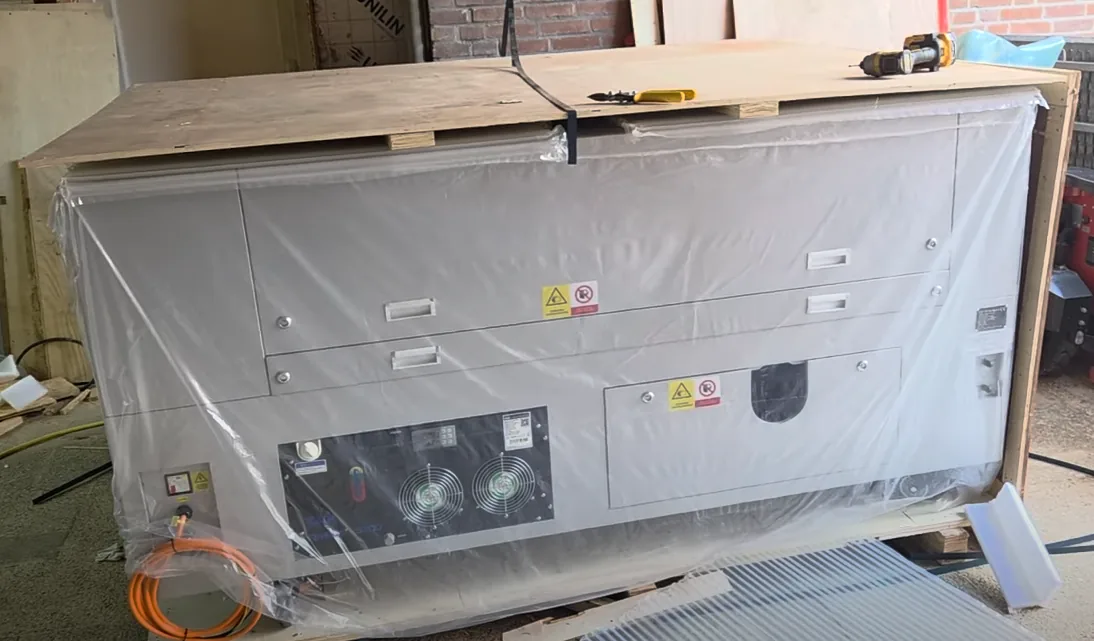
Photograph every face of every crate, shock/tilt indicators, labels, and visible damage. Compare the number of packages with the freight paperwork. Note damage or missing packages on the carrier record before signing where local procedure permits. Do not discard the crates until the machine has been inspected and commissioned.
Useful questions for Gweike before delivery
- What are the packed weights and lifting points for this serial number?
- What are the nameplate requirements for the machine, source, chiller, and supplied accessories?
- Which laser source and chiller are included?
- Which gases, inlet ranges, fittings, and purity are specified for my intended modes?
- Which mLaser version and factory parameter files belong to this machine?
- Who should receive commissioning photographs or alarm logs if support is needed?